for writing instructors

Feedback isn't learning. Revision is.

Co-note is a writing assignment platform where feedback becomes required revision work before grades are released. Works for essays, scaffolded drafts, and writing exercises

co-Note grader interface

Built by teachers who got tired of watching students skip over feedback.

No Resolution, No Grade.
lightweight Human-first works in your browser
join the beta

or try the free grading tool · no account required

co-Note
co-Note
Feedback isn't learning. Revision is.
Check it out on Product Hunt →
import & export with
C Canvas
Google Classroom Google Classroom
used by teachers grading
IELTS AP A-Level Cambridge IB

teachers already using co-note

John Alcayde

“My students actually open the feedback now — the grade forces them to.”

John Alcayde IELTS Teacher Philippines Philippines
Carmela Aguilar

“I stopped rewriting the same comment forty times a week.”

Carmela Aguilar Writing Teacher Philippines Philippines
Nomsa Mhango

“Resubmissions went from optional to automatic.”

Nomsa Mhango English Teacher Zambia Zambia
Zaki H.

“I grade a full batch from my phone in the evening.”

Zaki H. IELTS Tutor Algeria Algeria
Elma Hubert

“The error patterns show me exactly what to reteach.”

Elma Hubert Cambridge Writing Teacher UAE UAE

Learn how to use it in 60 seconds

Tag text, fill the rubric, hit submit — then see exactly what your student would receive.

nothing is saved · no credit card

pick your context
How it works
Co-note
1
Tag
Mark the problem. Don't fix it. Each tag is a comment pinned to the text.
The student have wentverb tense to the store yesterday.
2
Resolve
Student addresses every tag in revision. No skipping.
✓
verb tense — fix "have went"
✓
unclear referent — "it" in para 2
weak conclusion — needs a claim
3
Reveal
Grade unlocks only when all tags are resolved. Not before.
Final grade
6.5
co-note.run The revision is on them.
the full loop
CO-NOTE — WORKFLOW co-note.run
👩‍🏫  TEACHER
↕
🧑‍🎓  STUDENT
1📋
Create assignment
Write prompt, set deadline
2🔗
Share link
Open submission or by cohort
4🏷️
Tag feedback
Mark problems. Don't fix them.
6🔍
Compare
Original vs revision — loop or unlock
↓
link sent
↑
essay submitted
↓
tagged, returned
↑
revision in
↻ loop if
tags remain
3✍️
Submit essay
Writes via link — enters queue
5🔄
Resolve & revise
Every tag addressed. Grade hidden.
🔒
—
Grade locked
until all resolved
From assignment to grade
in four phases.
01
Setup & Administration
Create, configure, share.
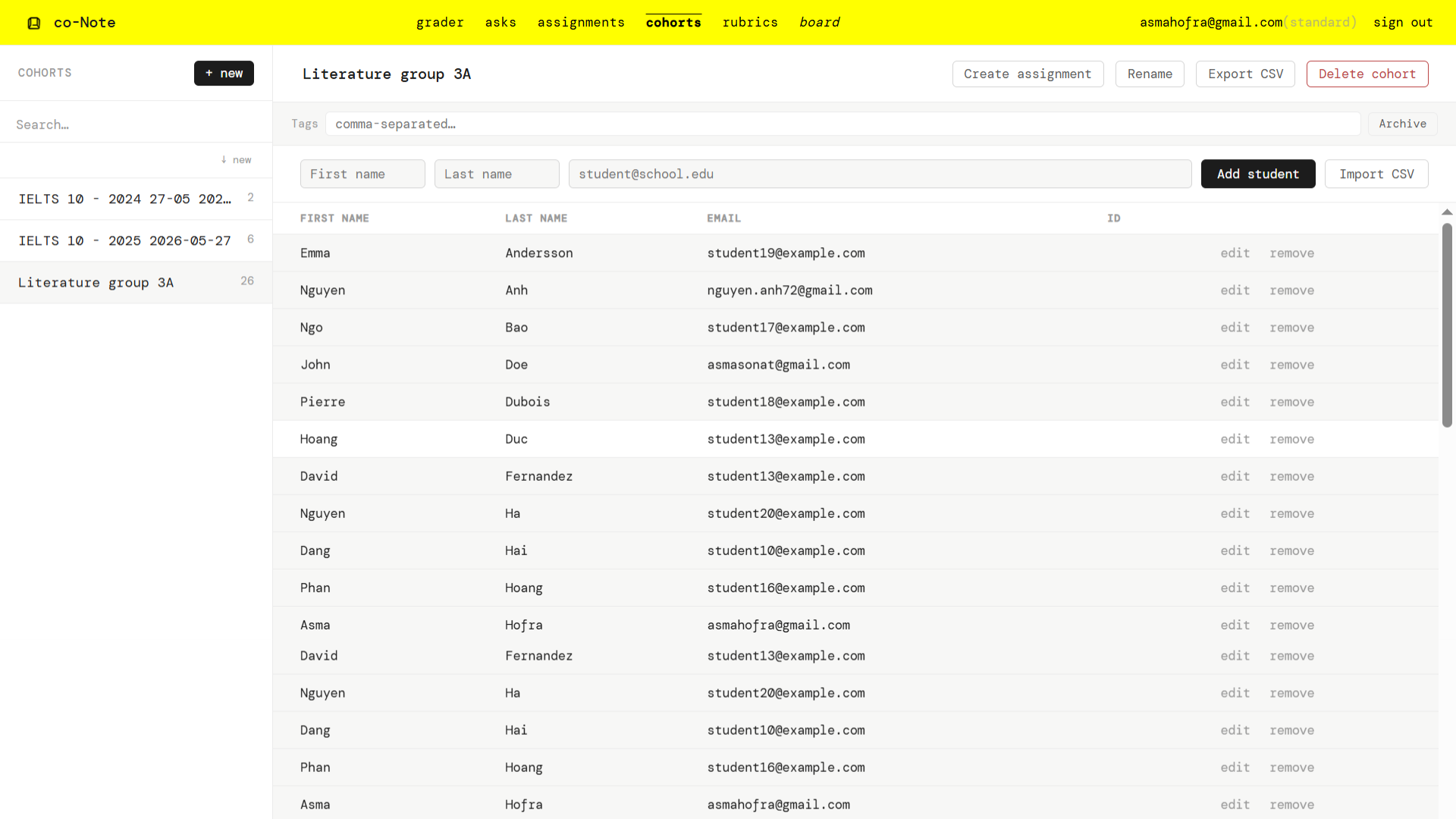
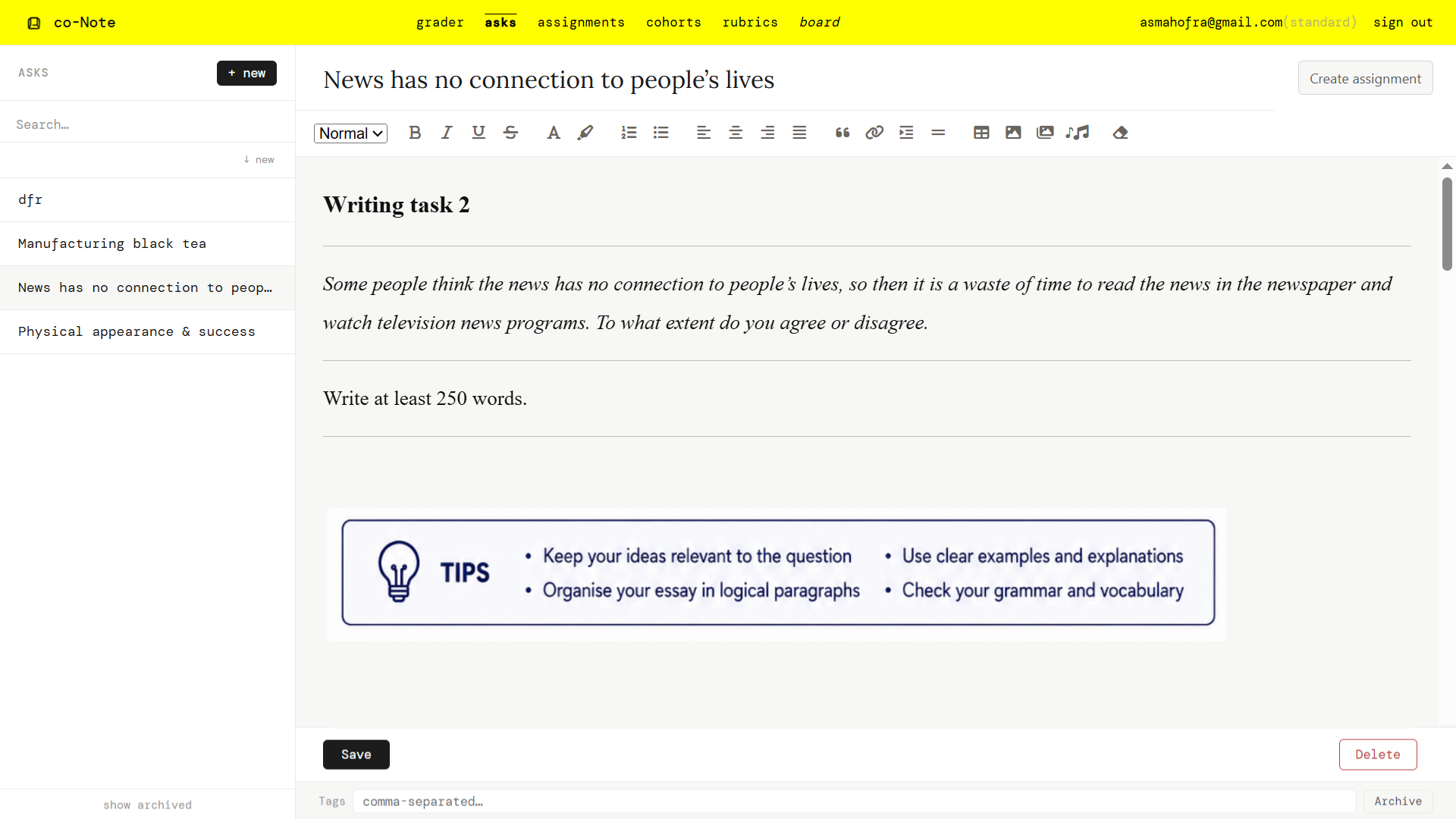
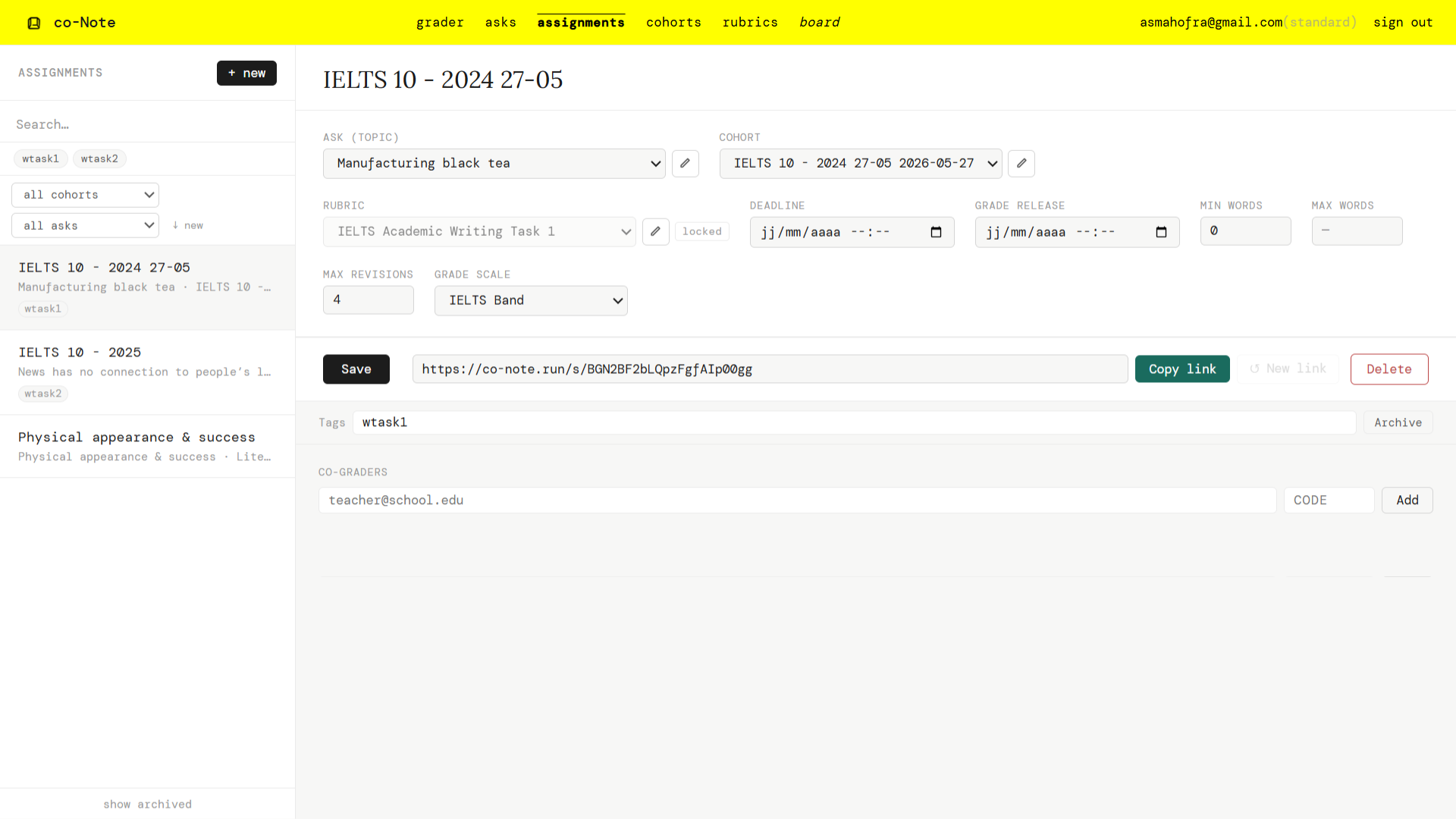
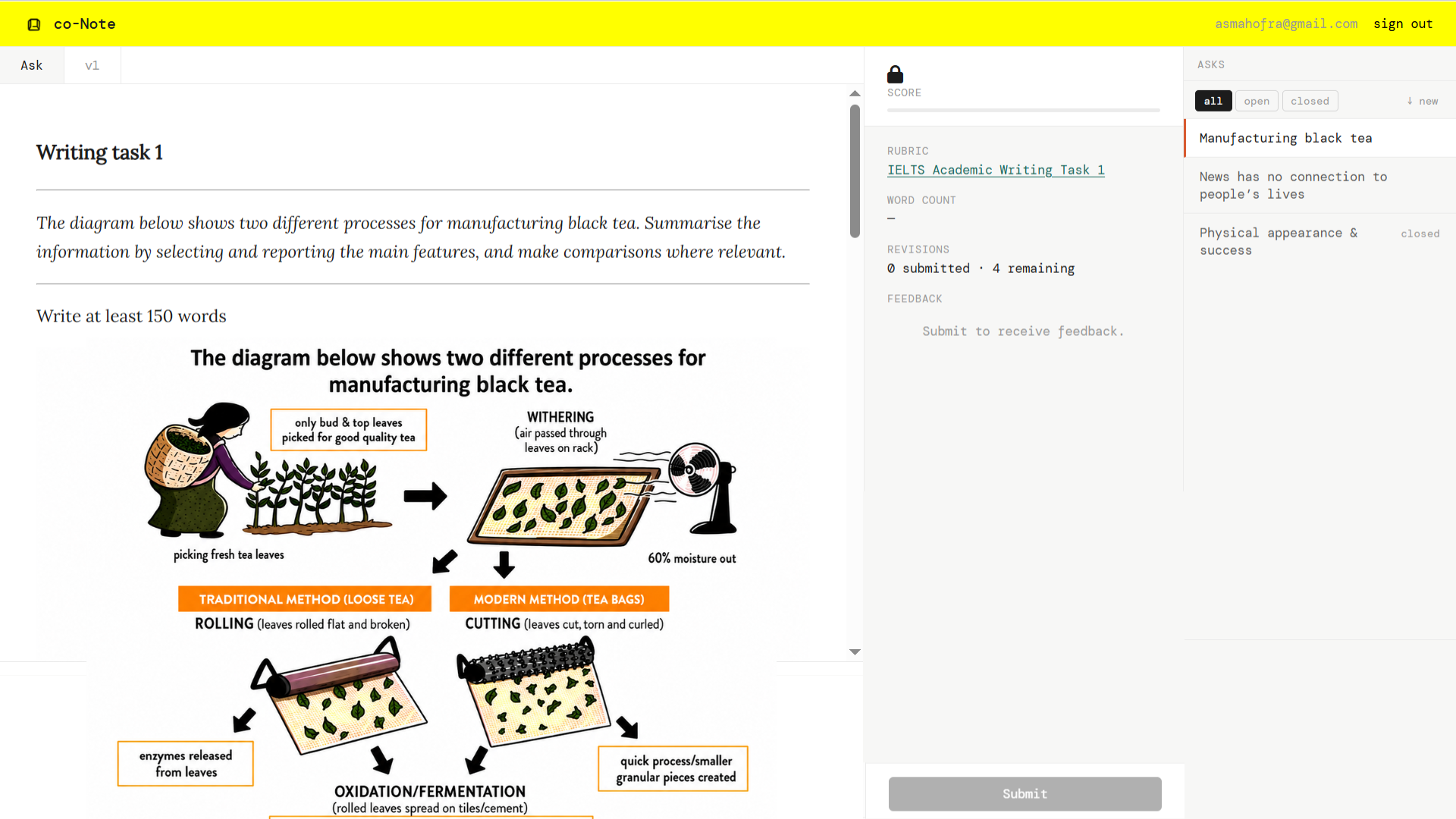
Create your student groups, your rubrics, your media rich prompts and share them.
1 · Manage cohorts2 · Ask & rubric3 · create a link
Create cohort
Create ask
Share link
02
Submission Window
Students submit. You watch the queue.
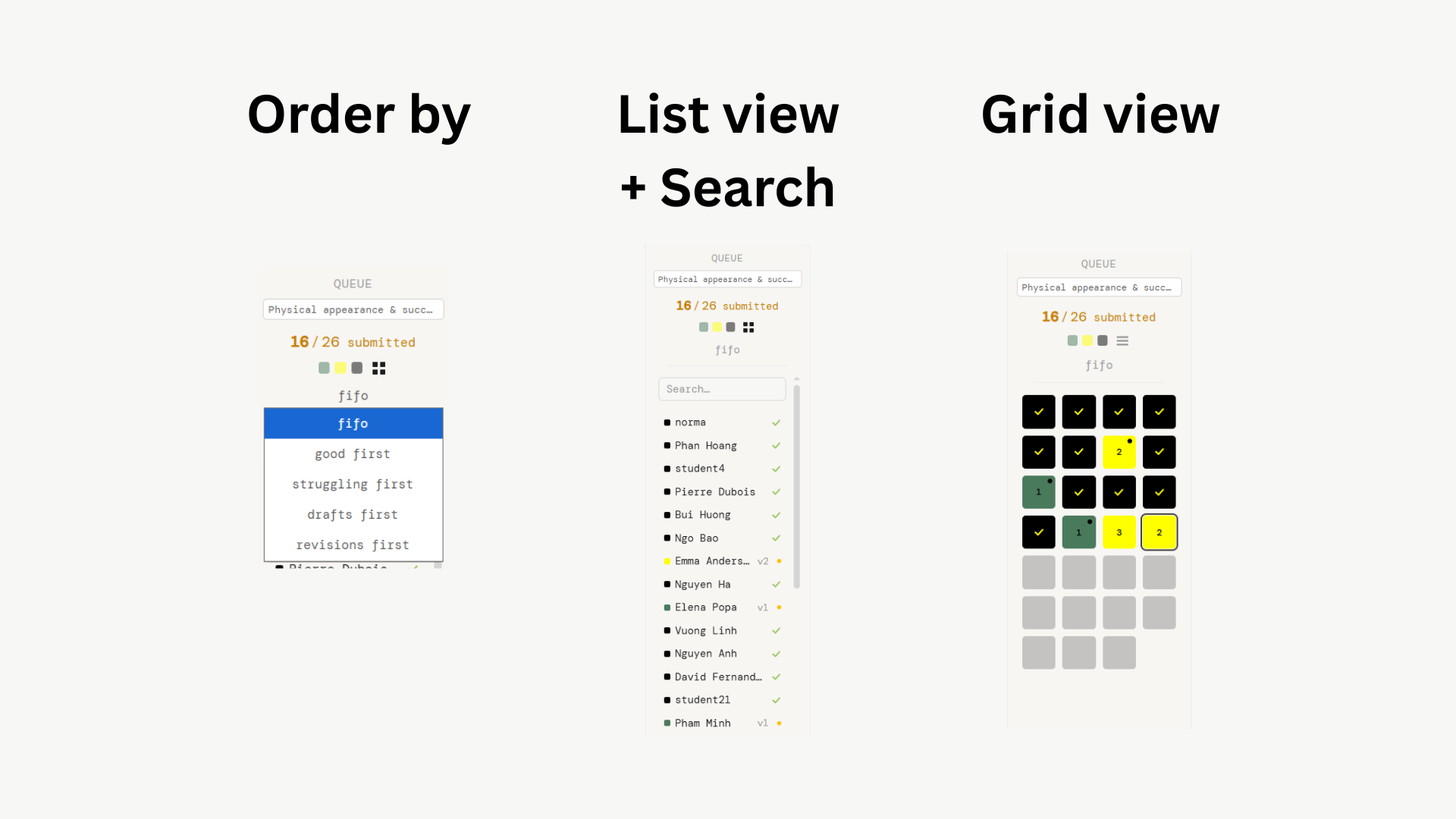
Real-time queue tracks every student — not submitted, first draft, in revision, done. Nothing slips through.
4 · Receive submissions5 · Analyse drafts
Submission queue
Order / filter submissions
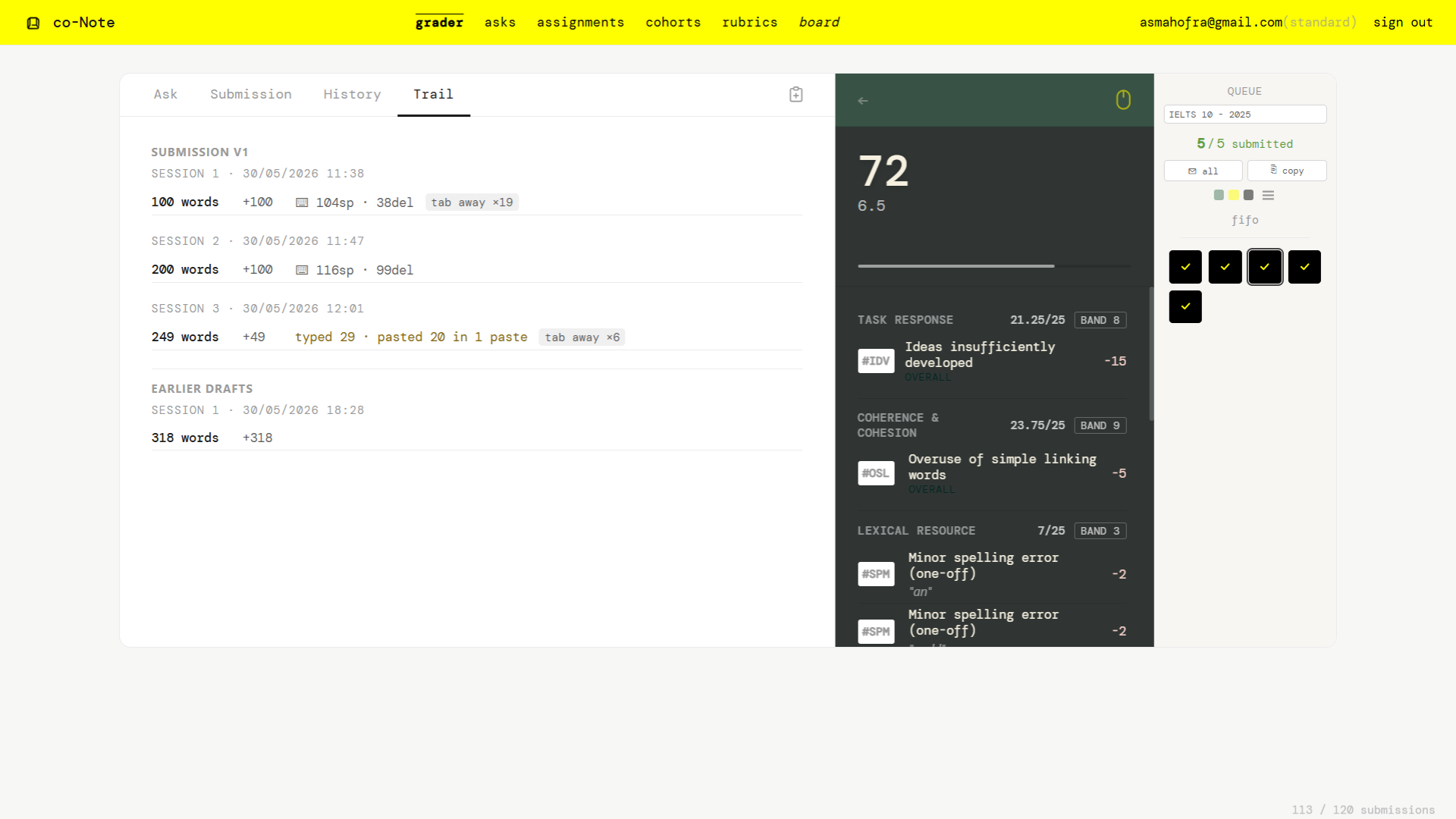
Behaviour trail
Behaviour trail
03
⭐ High-Speed Grading
Tag fast. Don't fix. Move on.
Open the grader, select text, drop an error code. Keyboard or mouse. Add custom comments where needed. Five essays, one sitting.
6 · Open grader7 · Select & tag errors8 · Apply rubric scores9 · Add custom comments10 · Send back
⌨️
Keyboard-driven
Navigate by paragraph. Apply tags with a keypress. Never leave the essay.
or
🖱️
Mouse-driven
Select text, click a tag type, move on. Familiar feel, faster than comments.
04
The Revision Loop
No resolution, no grade.
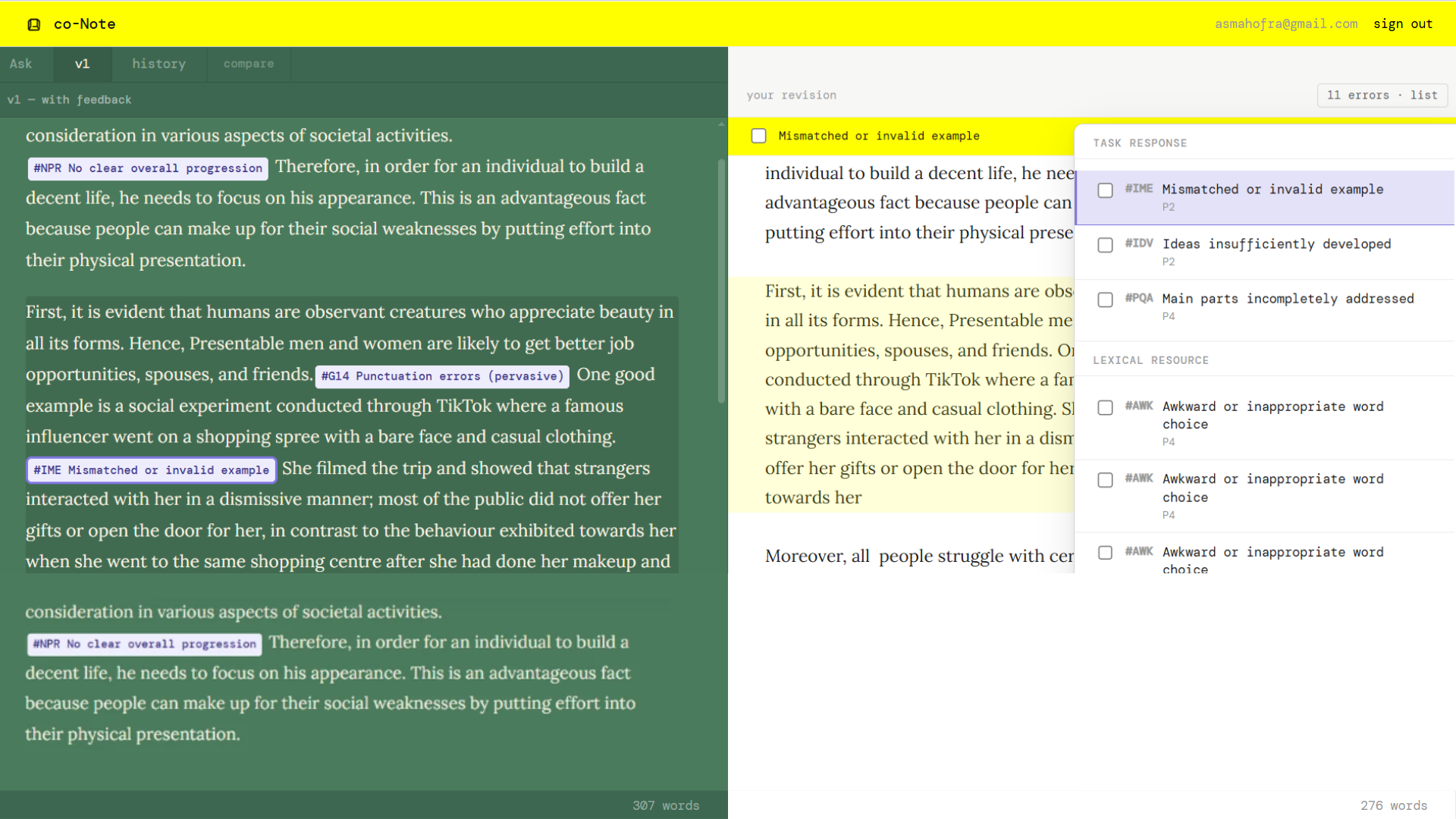
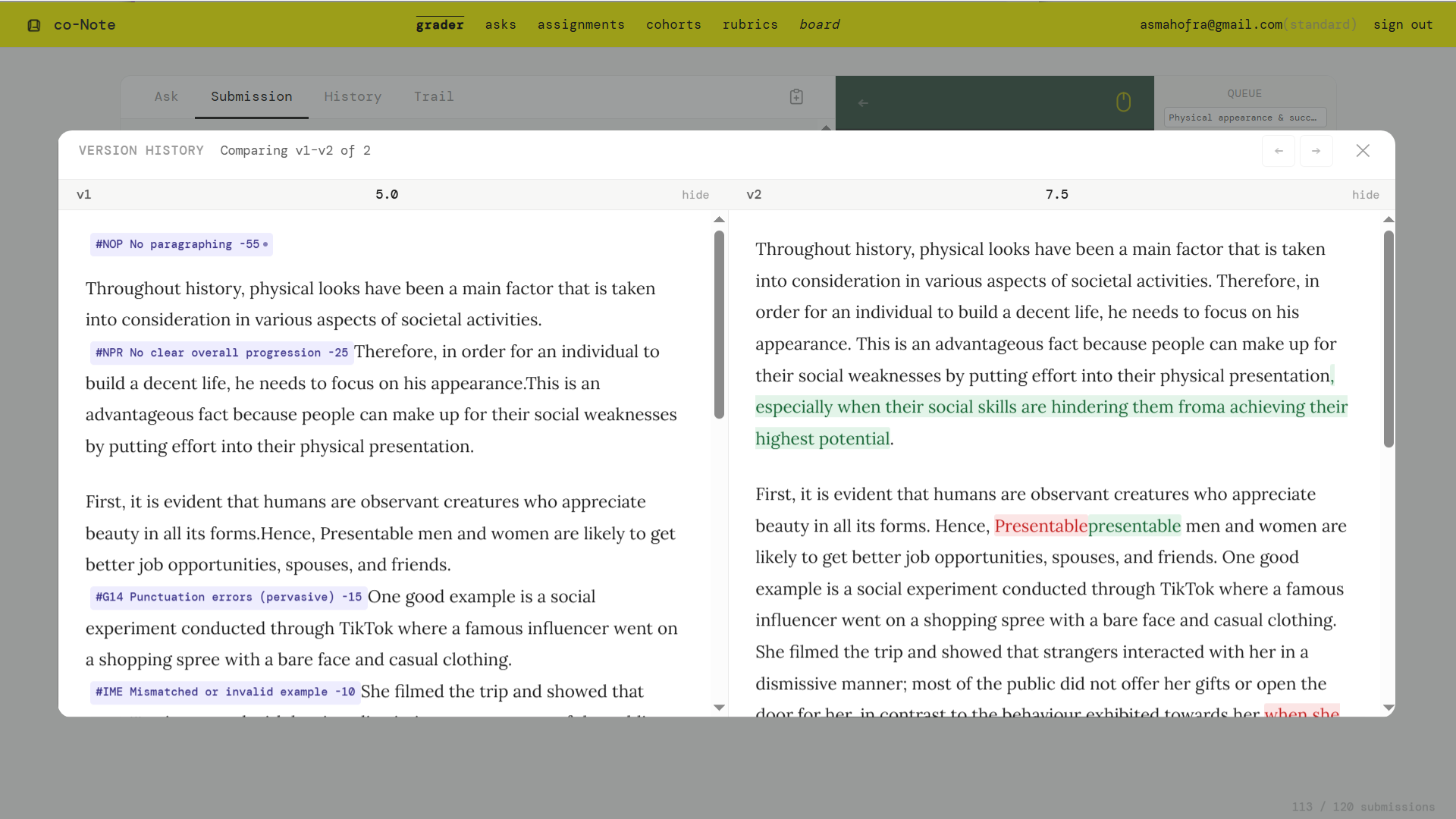
Student gets a to-do list, not a grade. They check off every tag, revise, resubmit. You compare original vs revision side by side. Loop or unlock.
11 · Student receives to-do list12 · Resolves each tag13 · Resubmits14 · Teacher compares & unlocks
Student to-do list
Student to-do list
Compare view
Compare view
Grade unlocked
Grade unlocked
Everything else you need.
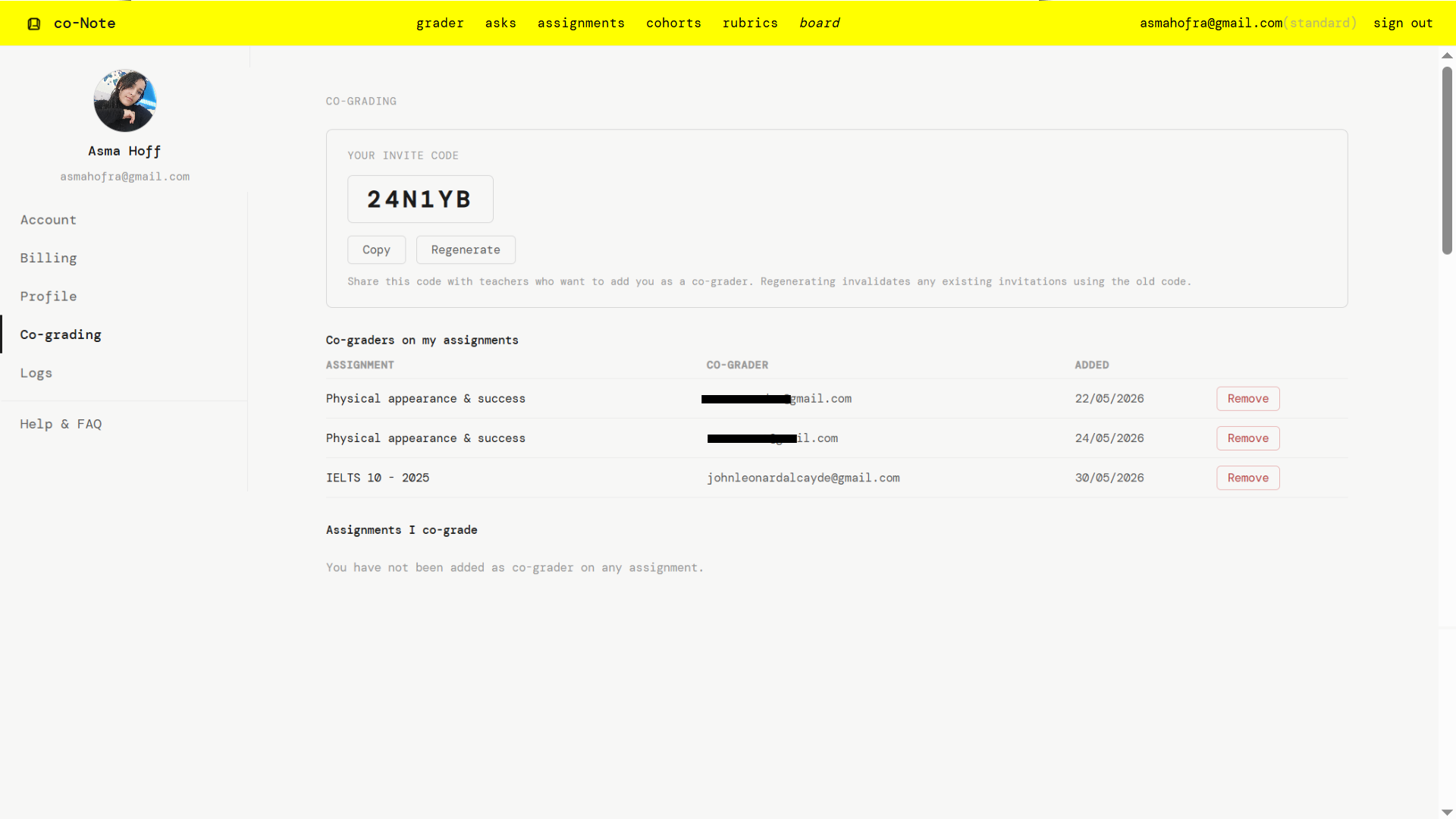
[ co-graders ]
Co-graders
Invite a colleague to share your grading queue. Split the load, stay consistent — more teachers, one workflow, no stepping on each other.
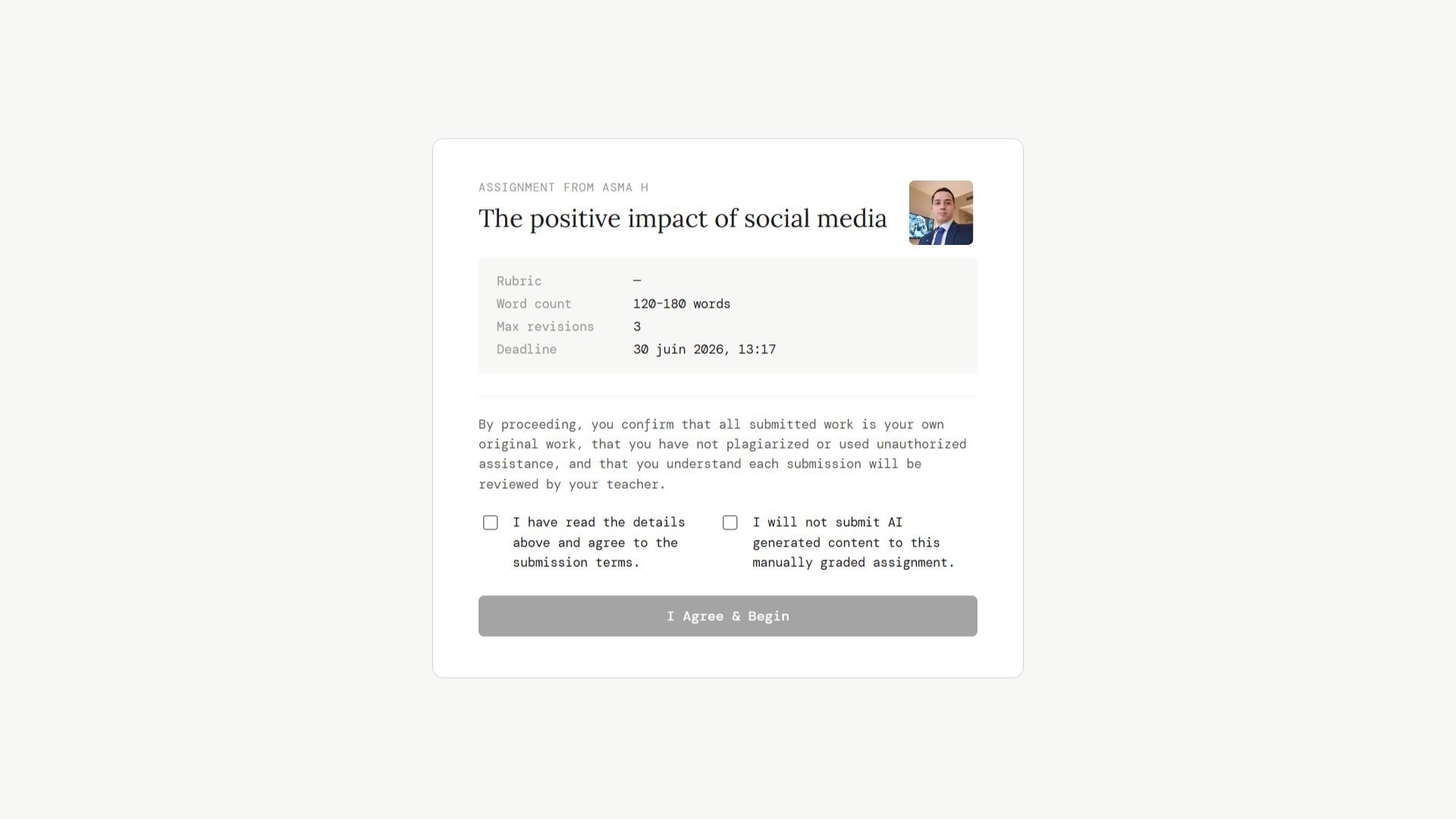
[ Consent forms ]
Consent forms
Before submitting, every student accepts the rubric and signs a no-AI integrity pledge — with a clear notice that a human will read every word.
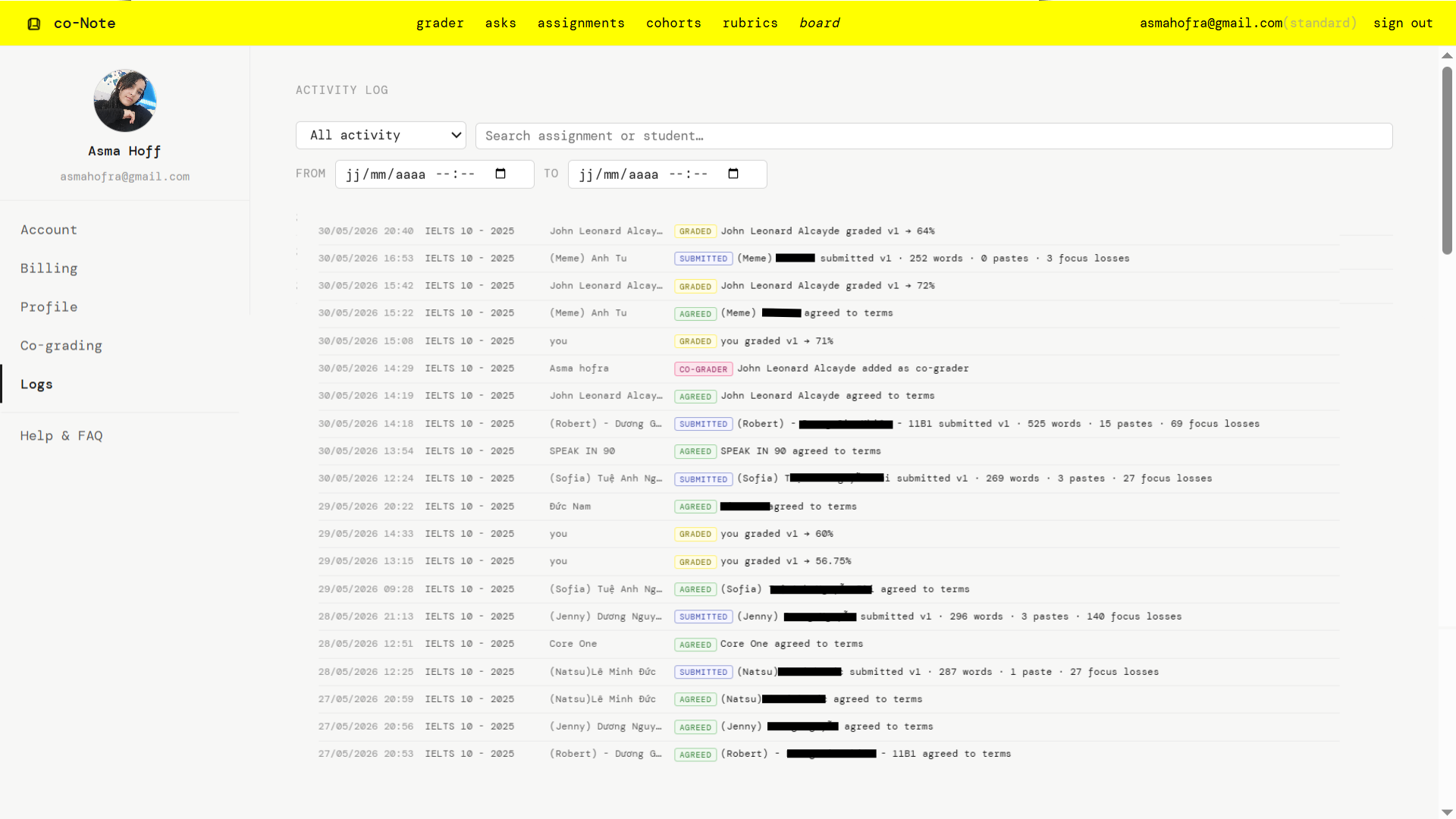
[ audit log ]
Audit log
Every action — tag, comment, score, revision — is timestamped and attributed. Students dispute grades. Co-graders make changes. You always know who did what and when.
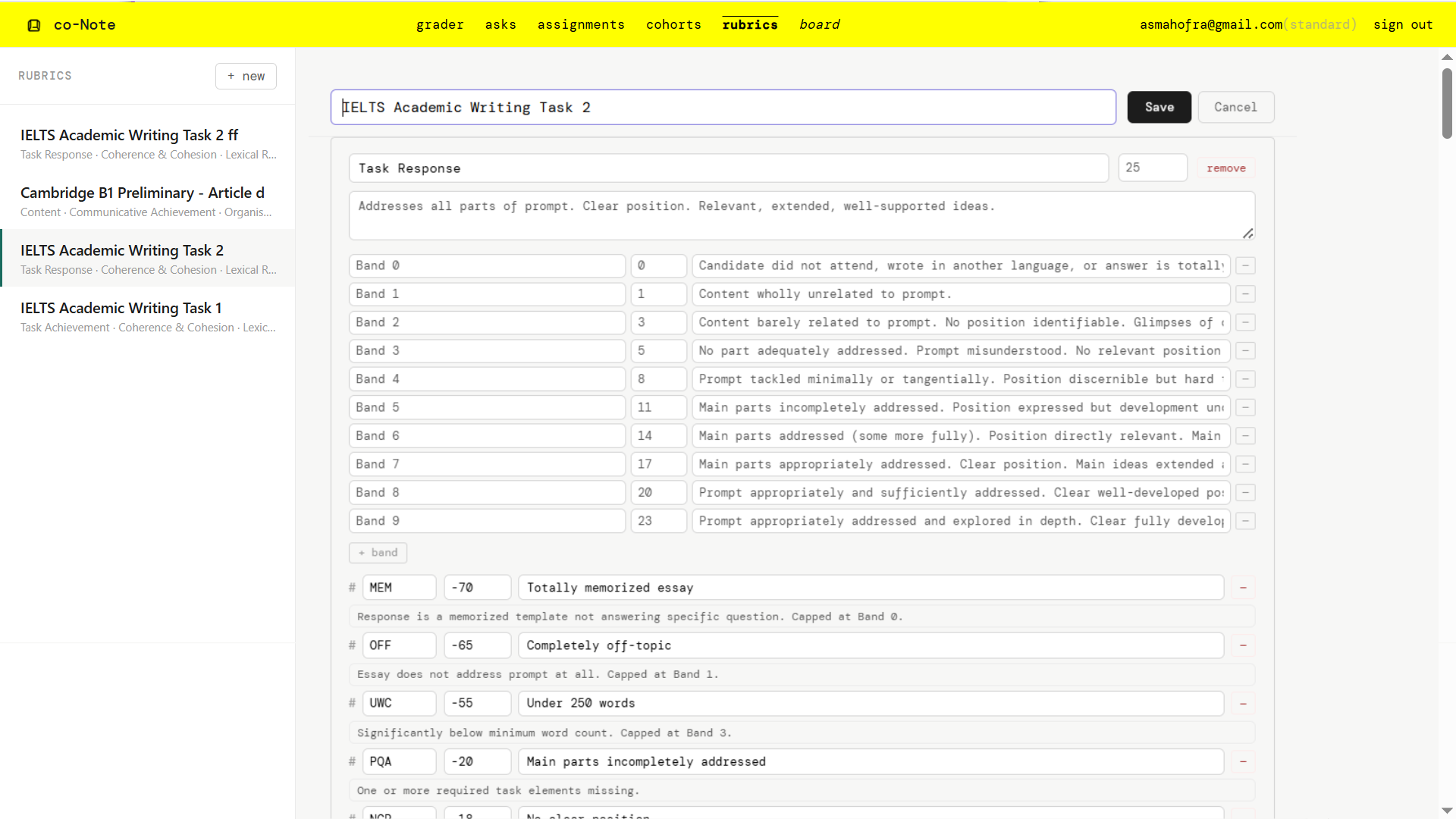
[ rubrics ]
Custom rubrics
Choose ready to use rubrics from the library or build your own rubric from scratch.
[ grading scales ]
Grading scales
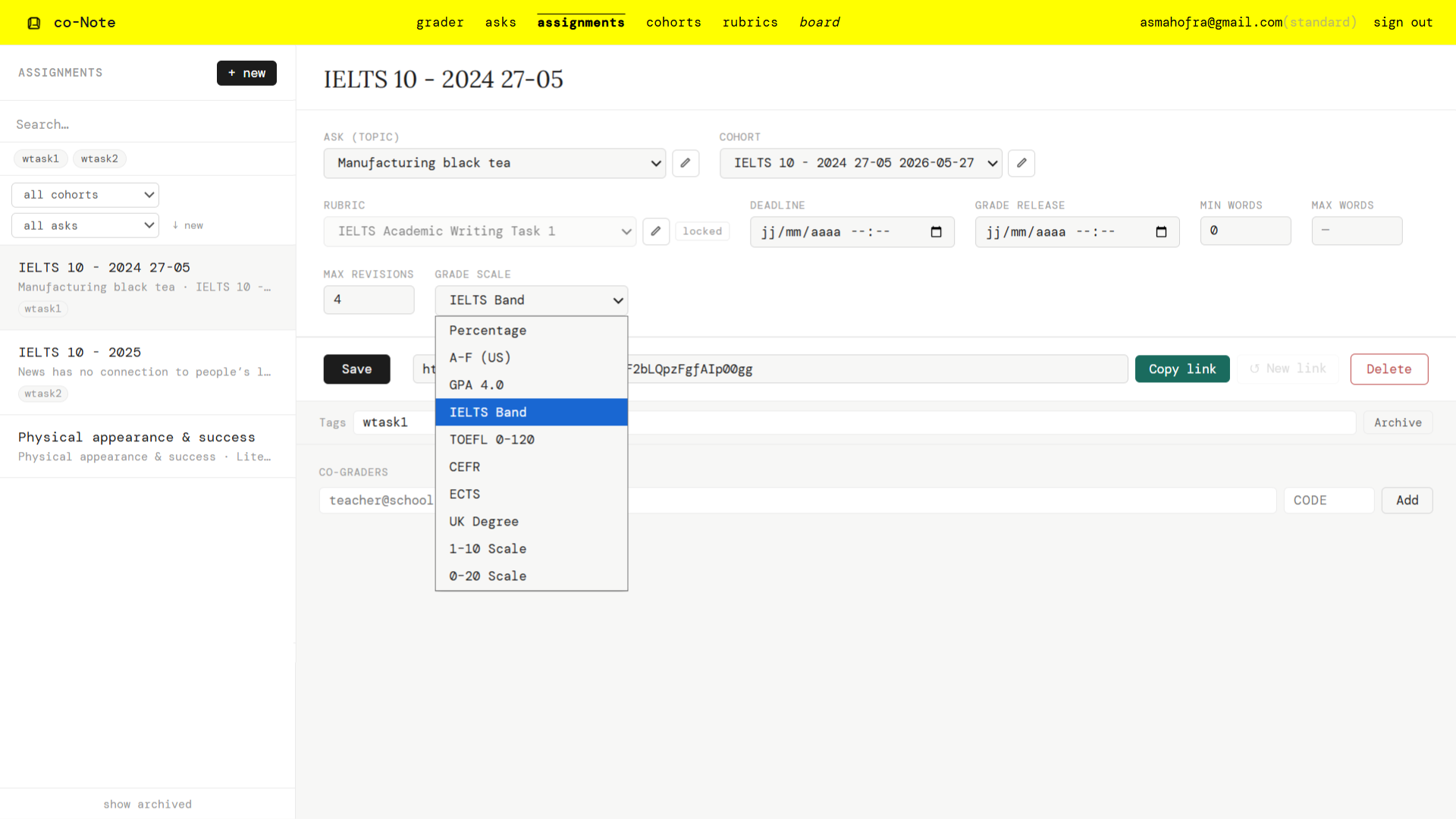
IELTS bands, percentage scores, letter grades, custom descriptors — configure the scale that matches your context. The grade that unlocks is always in your own terms.
[ history ]
Writing history
Every draft of every assignment, stored and accessible. Students build a portable writing portfolio. You get a full picture of how each student has progressed over time.
[ behaviour trail ]
Behaviour Trail
Every keystroke, paste, delete, and pause — logged. Before you read a single word, you know whether the student wrote it or dumped it. No AI detection. Just the truth of how the essay arrived.
One payment.
One term. No subscription.
You buy a pack of submissions. It lasts one term (3 months).
No recurring charges, no per-seat fees, no surprises.
✓ one payment covers your entire term — nothing monthly, ever
Starter
$24
per term  ·  3 months
120 submissions
~10 students  ·  3 rounds each
get started
Flex
$59
per term  ·  3 months
1,600 submissions
heavy load or multiple classes
get started
Top-ups available if you run out mid-term  ·  Upgrade any time  ·  Paid via PayPal
Asma, founder of co-Note
Asma — IELTS instructor, builder of co-Note

It started on a Tuesday, at 2 a.m., with 22 essays.

I had spent the whole night annotating: rubric rows filled, margin notes in full sentences, fixes suggested for every mistake. The next morning, I handed them back. Within thirty seconds, every student had flipped to the last page, looked at the grade, and put the essay away. Two students, the most studious ones, looked at the feedback and started mentally working on the changes they would make on the resubmission and had a few questions that I happily answered. The others just looked at me, waiting for the new lesson to start. One student asked me why he got that band, as if he didn’t hold in his hands the whole explanation in detail.

I stood at the front of the room and realised: everything I had written the night before was already in a mental bin. The feedback existed. It was just the fine print no one reads before they agree to terms and conditions, and I had stayed up until 2 a.m. grading.

I started experimenting with a simple rule: no grade until the feedback is resolved. Not read. Resolved. The student had to look at each tagged error, acknowledge it, and either revise the sentence or write a one-line response to show the work they'll do on the issue. Only then did the score unlock. If we didn't have much time, they could verbally tell me what they would change in each instance, and I could approve or deny on the spot. After all was settled, I would tell the student their grade and write it on the sheet in red ink.

Read the full story →
For teachers who refuse to lower the bar.
Standards, rigor, and essays gone wrong — weekly.
June 1, 2026
"In conclusion, slavery was wrong…"
Every writing teacher has read a hundred conclusions that conclude nothing. Here's what's actually going wrong — and what fixes it.
I've seen things →

May 25, 2026
The essay that went south like Sherman.
Introduction: strong. Overview: confident. Paragraph one: a different topic entirely. Paragraph two: missing.
I've seen things →
May 18, 2026
My student used "Plethora" three times by the second paragraph.
Once is vocabulary. Twice is enthusiasm. Three times is a new word she learned that morning.
I've seen things →

Spend less time perfecting feedback. Make sure it gets used.

Join the beta — or try the free grading tool first, no account required.

get started